
Requirement traceability
Every tested path is connected to a supplied requirement, workflow, or acceptance condition.
Specialized testing for business applications and precise technical documentation. We identify functional defects before they reach your users.


Our work is limited to software testing, update verification, QA records, and user procedure documentation. We do not provide financial, brokerage, investment, payment-processing, cryptocurrency, cybersecurity-monitoring, or client-fund-management services.
Each check is tied to a requirement, a reproducible result, practical severity, and a documented completion state.

Every tested path is connected to a supplied requirement, workflow, or acceptance condition.
Environment, preconditions, actions, observed behavior, and expected behavior stay together.
Findings are grouped by practical impact so corrections can be planned efficiently.
The package states what passed, what needs attention, and what remained outside scope.
Project pricing reflects a focused US-market engagement for a recently established specialist practice. Final scope depends on application size, environments, and documentation volume.

A structured review of core product logic using the requirements and scenarios you provide. We follow realistic user paths, identify functional deviations, and document the conditions under which they occur.
UI and UX scenario checks / crash and dead-end detection / business-rule verification / concise defect records

Testing activity becomes a clear operational record. We prepare structured test cases, repeatable checklists, issue documentation, and readable summaries for product and project teams.
Test-case preparation / testing checklists / reproducible issue records / management-ready QA summaries

We verify that the updated product still supports its essential user flows and that corrected defects remain resolved. Each cycle ends with a concise result report.
Before-and-after comparison / regression of primary scenarios / corrected-issue verification / release-readiness report

Complex software behavior is translated into practical instructions for employees and end users. Content is organized around repeatable tasks, clear prerequisites, and expected outcomes.
User procedures / standard-function guides / onboarding reference / knowledge-base structure
Pricing is a starting estimate in US dollars. A written scope is confirmed before work begins; additional browsers, devices, environments, integrations, or revision cycles may change the final fee.

We review product logic, supplied specifications, target environments, and the user paths that must remain dependable.

Requirements become test cases, checklists, expected results, and a clear boundary for the agreed audit.

Scenarios are executed, deviations are reproduced, and findings are documented with evidence for the product team.

Corrected defects and primary flows are checked again to confirm that changes did not create new functional problems.

The client receives the agreed QA summaries, issue records, test documents, and user procedures in an organized handoff.
Use the arrows, drag with a mouse, or swipe on touch devices
Each output is organized around the agreed scope and the next practical action for the product team.
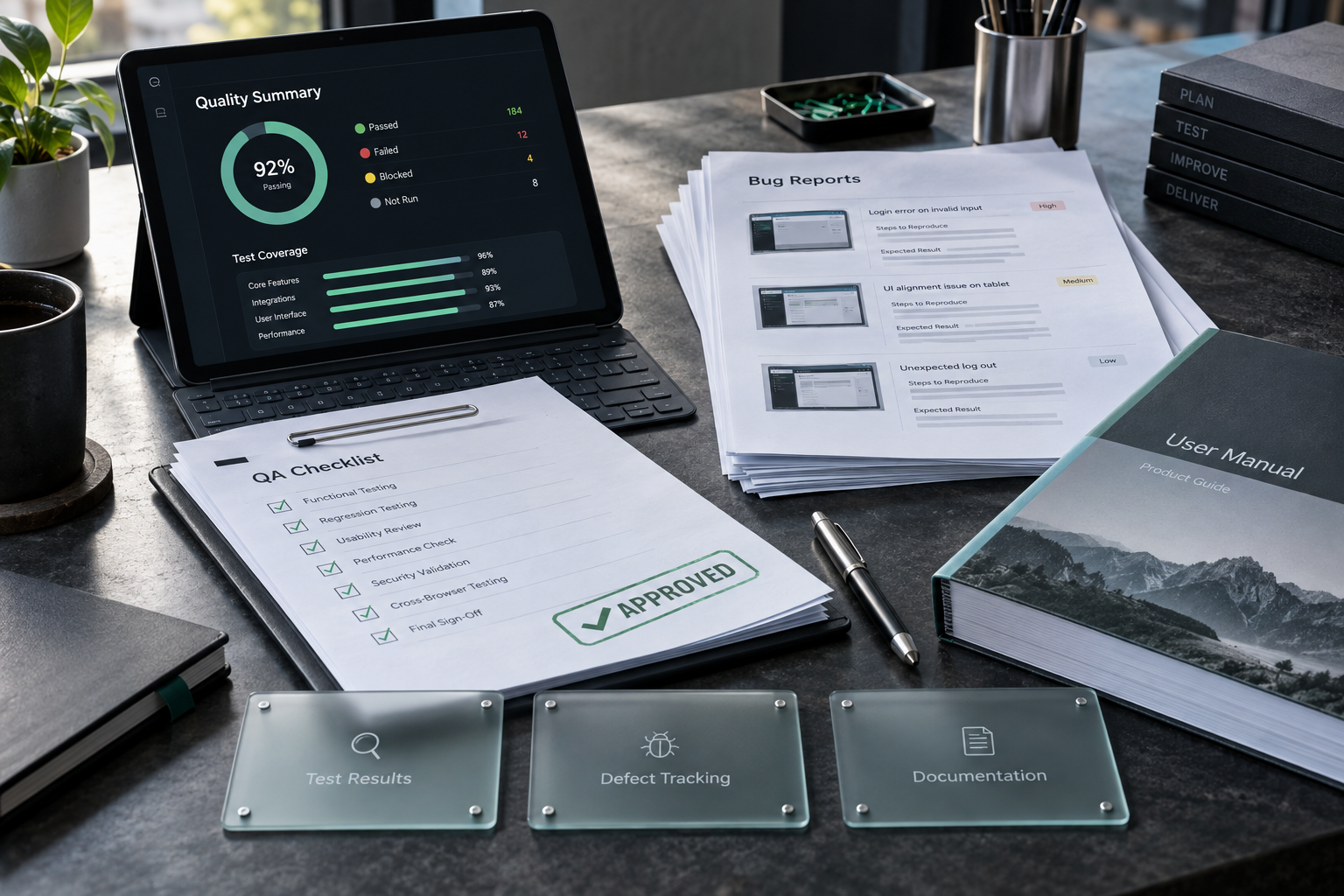
A concise view of scope, execution status, observed quality risks, passed scenarios, unresolved findings, and practical next steps.
READY FOR HANDOFF
Reproduction steps, environment notes, expected and observed behavior, priority guidance, screenshots, and supporting evidence when included in scope.
READY FOR ROUTING
Task-based instructions and reference material supplied as organized source content for PDF or web-based knowledge systems.
READY FOR USESensitive credentials should not be sent through the website form. Secure access arrangements are confirmed separately after scope review.
A safe test environment, build, or accessible product URL appropriate to the approved scope.
Requirements, acceptance conditions, or a concise description of what each core workflow should accomplish.
The browsers, devices, operating systems, roles, and application versions that matter to the engagement.
The functions that carry the greatest operational importance or have changed in the current release.
Browsers, devices, user roles, builds, and test data are confirmed before execution so results remain comparable and reproducible.

Agreed interfaces are checked where the product is expected to operate, with environment details kept beside each result.

Permission-sensitive paths are evaluated against the roles included in scope.

Known inputs make expected and observed behavior easier to compare.
Coverage is defined per engagement. Unsupported devices, browsers, roles, or integrations are recorded as outside scope instead of being implied.
Share the product link, expected workflows, and the service you need. The form records your request on screen and does not transmit sensitive access credentials.